
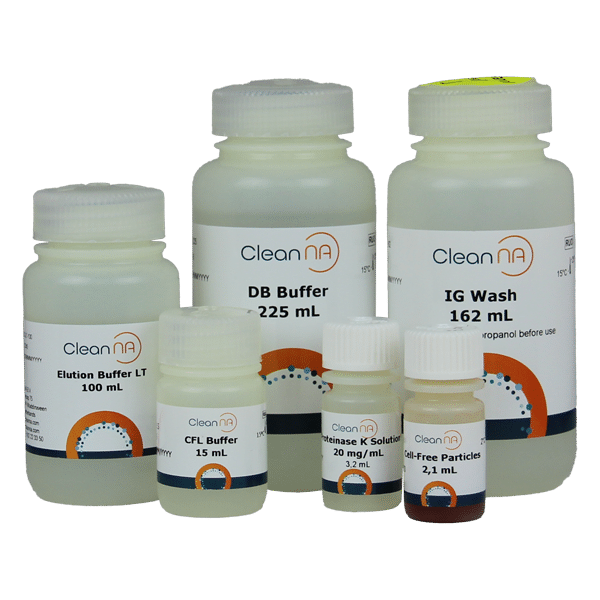
Cell-free DNA (cfDNA) has emerged as a powerful tool in both diagnostics and research. Over the last years, cfDNA had a major impact on prenatal screening by enabling non-invasive prenatal testing (NIPT). The biomarker is now being explored in the fields of oncology, transplant medicine, and cardiovascular diseases as well. Our Clean Plasma cfDNA Kit supports laboratories with the critical first step of the process: extracting the cfDNA from human plasma.
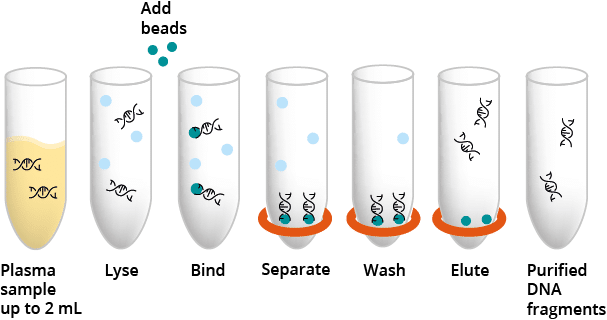
Our kit extracts cfDNA fragments from up to 2 mL human plasma or cerebrospinal fluid using a simple three step procedure. A unique lysis buffer releases the DNA from proteins and vesicles, while an optimised buffer combination enriches DNA fragments ranging from 120 to 400 base pairs.
The protocol is compatible with both manual and automated workflows, including integration with our CleanXtract LV and CleanXtract 96. The resulting cfDNA is ready for downstream applications, making the Clean Plasma cfDNA Kit the ideal starting point for your cell free DNA workflow.
Both diagnostic and research workflows can benefit from utilizing our Clean Plasma cfDNA Kit, since we offer a CE IVD certified (Dx) as well as a Research Use Only version.
We extracted cfDNA from 5 replicates of a 1 mL human plasma sample using the Clean Plasma cfDNA Kit. The extraction was performed on the Dynamic Devices’ Lynx liquid handling instrument and the samples were analysed on the 5300 Fragment Analyzer System. Figure 1 shows a high peak around the length of 170 base pairs, indicating that our Clean Plasma cfDNA Kit captures small DNA fragments of the size of cfDNA (Faas et al., 2012). The height of the peaks (showing DNA quantity) is similar, which means high reproducibility.
FIGURE 1.
Electropherogram of DNA from 5 replicates of a human plasma sample after extraction with the Clean Plasma cfDNA Kit.

Next to extraction from replicate samples, cfDNA was extracted from 4 clinical human samples of 2 mL. Because the plasma samples were from different
patients, the quantity of cfDNA varies. A high peak is visible around 160 base pairs, which shows that the kit extracts cfDNA from clinical plasma samples.
FIGURE 2.
Electropherogram of DNA from 4 clinical human plasma samples after extraction with the Clean Plasma cfDNA Kit.

In another experiment, DNA extraction from 8 replicates of a 1 mL human plasma sample was performed by using the Clean Plasma cfDNA Kit. The extraction was performed on Dynamic Devices’ Lynx liquid handling instrument. We performed a qPCR on the human albumin gene. Figure 3 shows minimal differences in Ct-values for the different samples, which indicates high reproducibility.
FIGURE 3.
Albumin directed TaqMan® qPCR performed after extracting DNA from 8 replicates of a human plasma sample with the Clean Plasma cfDNA Kit.

Faas BH, de Ligt J, Janssen I, Eggink AJ, Wijnberger LD, van Vugt JM, Vissers L, Geurts van Kessel A. Non-invasive prenatal diagnosis of fetal aneuploidies using massively parallel
sequencing-by-ligation and evidence that cell-free fetal DNA in the maternal plasma originates from cytotrophoblastic cells. Expert Opin Biol Ther. 2012 Jun;12 Suppl 1:S19-26. doi: 10.1517/14712598.2012.670632. Epub 2012 Apr 16. PMID: 22500971.